
Avoid These Three Critical Mistakes in Tile Selection for Home Renovation – Expert Tips and Guidelines for Quality Assurance
Home renovation is a time-consuming and challenging task, especially if not done correctly the first time, as redoing it can be frustrating. Therefore, homeowners must be diligent when selecting materials and managing renovations. Tiles cover a significant area and are used for extended periods, so it is crucial to prioritize this aspect of material selection. Investing in high-quality tiles from reputable sources is essential and should not be overlooked. Below, we outline key techniques for choosing the best tiles. (Three misconceptions to avoid when selecting tiles)
Six essential techniques for selecting high-quality tiles:
The tile color should be uniform, with excellent surface smoothness and flatness, regular edges, and complete patterns. Inspect four to five tiles from a box for color variations, deformations, or defects like chipped edges or corners. Generally, clearer tile colors are preferable. Check visually for pinholes, as they can trap dirt and impurities.
Tiles are categorized into superior grade, first grade, second grade, third grade, and off-grade. Due to price variations, verify that the labeled grade matches the actual quality, and look for clear product certifications, trademarks, and quality inspection labels. High-quality tiles are free from bumps, bulges, or warping. Edges should be straight and flat, with side length errors not exceeding 0.2–0.3 cm and thickness errors within 0.1 cm; otherwise, they are substandard. Premium tiles facilitate easier installation, resulting in smooth, aesthetically pleasing surfaces, while also saving time, materials, and offering durability. Be cautious of tiles with side lengths over 0.2 cm incorrectly packaged as first-grade. Additionally, check for issues like missing glaze, cracks, peeling, damage, or adhered contaminants.
High-quality tiles feature consistent patterns, designs, and colors, with refined craftsmanship that appears visually appealing and free from color bleeding, misalignment, broken lines, or uneven shading.
Use sound to assess density. Tapping tiles produces a crisp sound if they have high ceramic density and hardness, indicating good quality. Alternatively, hold a tile corner with your left thumb, index, and middle fingers, let it hang loosely, and tap the mid-lower section with your right index finger. A clear, resonant sound denotes superior quality, while a dull, muddy sound suggests inferiority.
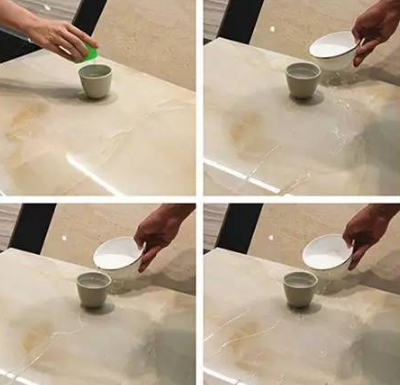
Conduct a water absorption test by dropping water on the tile’s back and observing the spread and absorption rate. Slower absorption indicates lower water absorption, higher internal stability, and greater density, making tiles ideal for humid areas like bathrooms and kitchens, as they resist issues like black spots. Faster absorption points to lower density and stability, increasing the risk of problems. A common method is pouring water on the tile’s back—slow or no absorption signifies better quality. (Tip: Methods for selecting and maintaining tile flooring)
Perform on-site measurements using a ruler or tape to check the tile’s sides and diagonals for accuracy. Higher dimensional precision ensures better installation results, and quality tiles simplify construction while saving time and materials. Measure each tile for consistency; superior tiles exhibit minimal size variations. Standard sizing is key to judging quality—use a tape or caliper to verify diagonal, side, and thickness uniformity. Good tiles emit a crisp sound, indicating high ceramic content, whereas a cracking noise may reveal internal fractures.
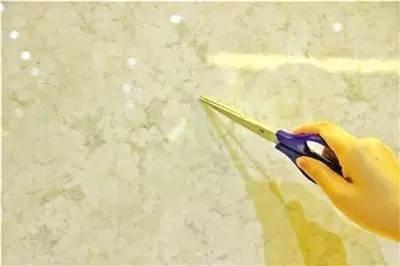
Evaluate surface quality by scratching the glaze with a hard object to test hardness.
Assess hardness and durability; superior tiles are hard, tough, and resistant to breakage. Examine broken fragments from shipping—fine, dense fractures with uniform color indicate quality. Scratch tile edges against each other; if they leave marks without powdering, they are high-grade, while powdering suggests poor quality. Quality tiles are easier for professionals to install, ensuring a standardized and neat finish.





 WhatsApp contact me online